A new alphabet is the first wall in a language like Georgian, Armenian, Arabic or Russian. Every word looks like a drawing, and you can't look anything up because you can't tell the letters apart. Plenty of people quit right here, or lean on romanized spelling and never quite leave it behind.
Of everything in the main Vocabi app, the alphabet scroll is one of our favorite things. You learn each letter by writing it yourself, on an old paper scroll, before you ever see a vocabulary list. Try a few letters below, or start your own scroll at vocabi.ca.
Dip your finger, then write
If your new language uses a script you can't read, Vocabi asks whether you'd like to be taught it. Already read it? Say so and skip straight ahead. If not, you get the scroll.
- A few letters open at a time. You can hear each one and see what it sounds like.
- You dip your finger in the ink. The line thins as the ink runs low and as your hand speeds up, so it pays to slow down. One dip is always enough to finish a letter.
- You trace the letter. It doesn't have to be perfect. Stay close and cover enough of the shape, and it counts.
- The next letter opens. Each letter you trace moves you along the scroll.
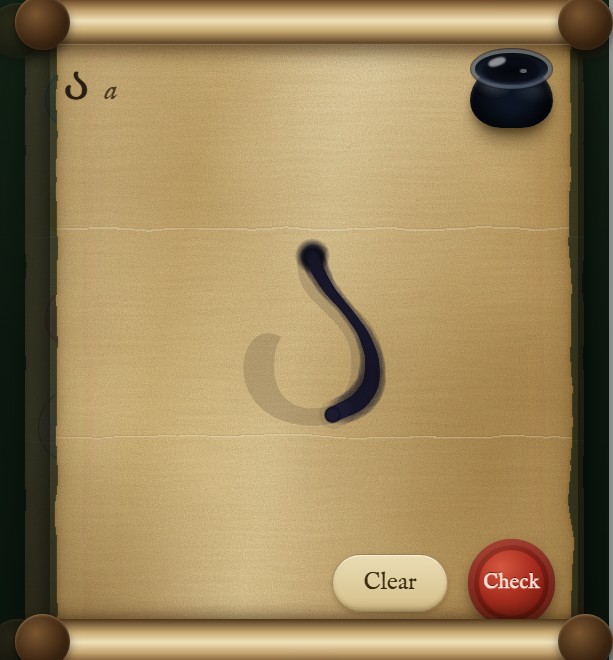
Try it: trace three letters by hand
Pick an alphabet, press the ink pot, then trace the faint letter with your finger or mouse.
Dip your finger in the ink to start.
A small demo of Vocabi's alphabet scroll. Nothing here is saved, its scoring is simplified from the app's, and Arabic letters appear in their standalone form. Want the real thing? Start at vocabi.ca.
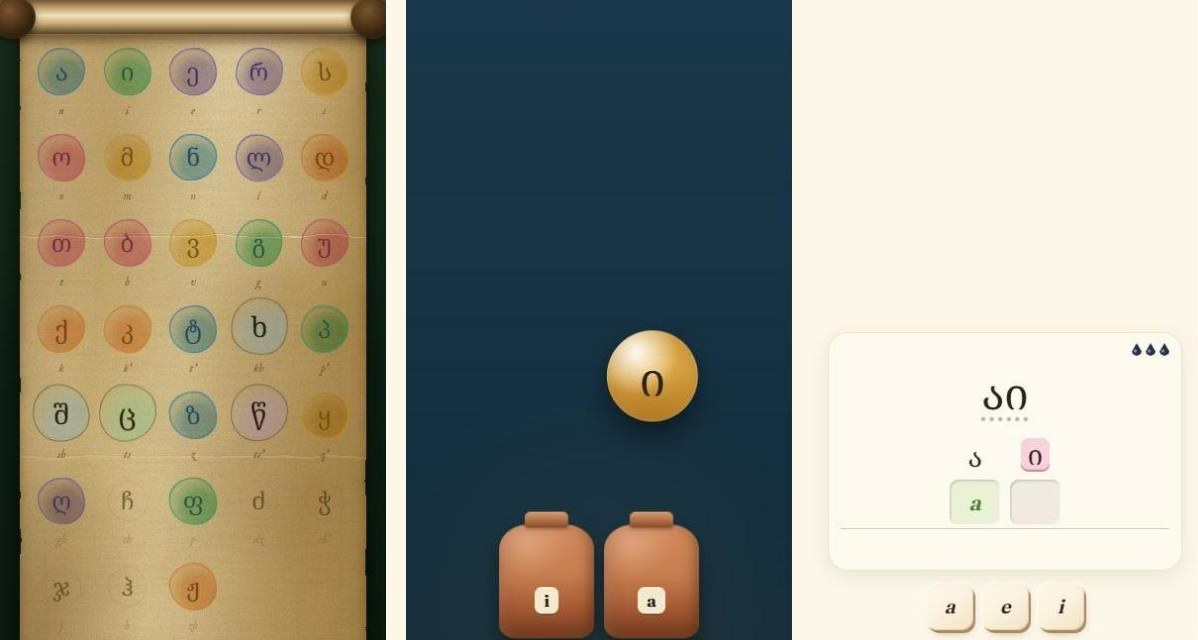
Two more letter games open as you go. In Sorting, you drop each letter into its jar. In Transcribe, you write out your first real words, one sound at a time. That's a lovely moment: a shape that meant nothing last week is now a word you can sound out.
You also don't have to master it all before moving on. Trying every letter once is enough to open the rest of Vocabi, so the alphabet is never a locked door. You can keep practicing while you learn your first 100 words.
The alphabets you can learn
Vocabi teaches four alphabets this way:
- The Georgian alphabet, for Georgian.
- The Armenian alphabet, for Armenian.
- The Arabic alphabet, for Arabic.
- The Cyrillic alphabet, for Russian, Ukrainian, Serbian and Kyrgyz.
How it compares
Two other apps are worth knowing here, and one of them goes further than we do on a key point.
Disclosure: this article comes from the people who make Vocabi, so check each product's own page too.
| Vocabi | Write It! | Duolingo | |
|---|---|---|---|
| How you practice | Tracing on a scroll, then Sorting and Transcribe | Writing from memory, with feedback on each stroke | Reference charts and lessons, with tracing for Arabic and Japanese |
| Scripts covered | Georgian, Armenian, Arabic and Cyrillic alphabets | Japanese, Korean, Chinese, Arabic, Hebrew, Greek, Russian, Thai and more | Part of its courses, such as Russian, Korean, Arabic and Hindi |
| What comes next | Word games, and a village that grows as you learn | Thousands of words for writing practice | The rest of the language course |
| Where it runs | Android and the web | iPhone and iPad (the listing we checked) | Across its apps |
| Cost | Free, with light ads in the games | Free, with ads and a paid Pro option | Free to start, with paid tiers |
If stroke-perfect handwriting from memory is your goal, Write It! is the stronger tool, especially for Japanese and Chinese, where stroke order matters a lot. Duolingo is a natural fit if you're already in one of its courses and want the script folded in along the way. Its blog post on these tools dates from 2021, so the app may have moved on.
Vocabi's scroll aims at something different: getting you reading quickly, in a way that feels pleasant, for scripts that many apps skip. Georgian and Armenian didn't appear in the Write It! listing we checked.
Why writing might help you read
Most people learning an alphabet want to read, not to win a calligraphy prize. So does writing help? One study suggests it does.
Wiley and Rapp (2021) taught the Arabic alphabet to 42 adults, split into three groups: writers, typers and video watchers. Everyone learned to recognize the letters, but the writers got there faster, some in just two sessions. They were also better at writing, spelling and reading unfamiliar words. The researchers credit the way handwriting ties together a letter's shape, sound and movement.
We should be careful with this, because it isn't a test of Vocabi. Those writers copied letters with pen and paper, while you trace with a finger on a phone. Tracing also asks less of you than writing from memory. It's one study of one alphabet, and we read press summaries because the full paper is behind a paywall.
Still, it's why we built the scroll around your hand. Our hope for Vocabi is simple: if you've formed a letter yourself, even with a fingertip, it may stop being a drawing and start being something you know. For anyone who stalled at the alphabet before, that could be the difference between giving up and reading your first word.
Where it falls short
- It won't teach you beautiful handwriting. A forgiving tracer isn't a calligraphy teacher, and it doesn't drill you from memory.
- A finger isn't a pen. If you'll need to write by hand, keep a notebook nearby too.
- The script list is short. Thai, Hindi and Korean aren't on it for now.
- There's no iOS app. Vocabi runs on Android and the web.
Enjoyed the demo? Start with one letter at vocabi.ca, or get Vocabi on Google Play.
Not ready to install? Take a quick look at Vocabi first.
Want the bigger picture? Read about Vocabi or see how to choose a language app in 2026.
Sources
Checked 5 November 2026. Details of Vocabi come from the product itself.
- ScienceDaily: handwriting study by Wiley and Rapp (press release; study in Psychological Science, 2021)
- Neuroscience News: the same study
- Write It! on the App Store
- Duolingo: tools for learning other writing systems (July 2021)
- Duolingo: learning to read Japanese characters (seen in search results only)